




Hair transplantation is one of the most effective solutions for hair loss and baldness. However, since it is a medical procedure, many patients naturally wonder about the potential side effects before making a decision.
To help you prepare and put your mind at ease, here are the most common side effects of a hair transplant and what you can expect during the recovery process.
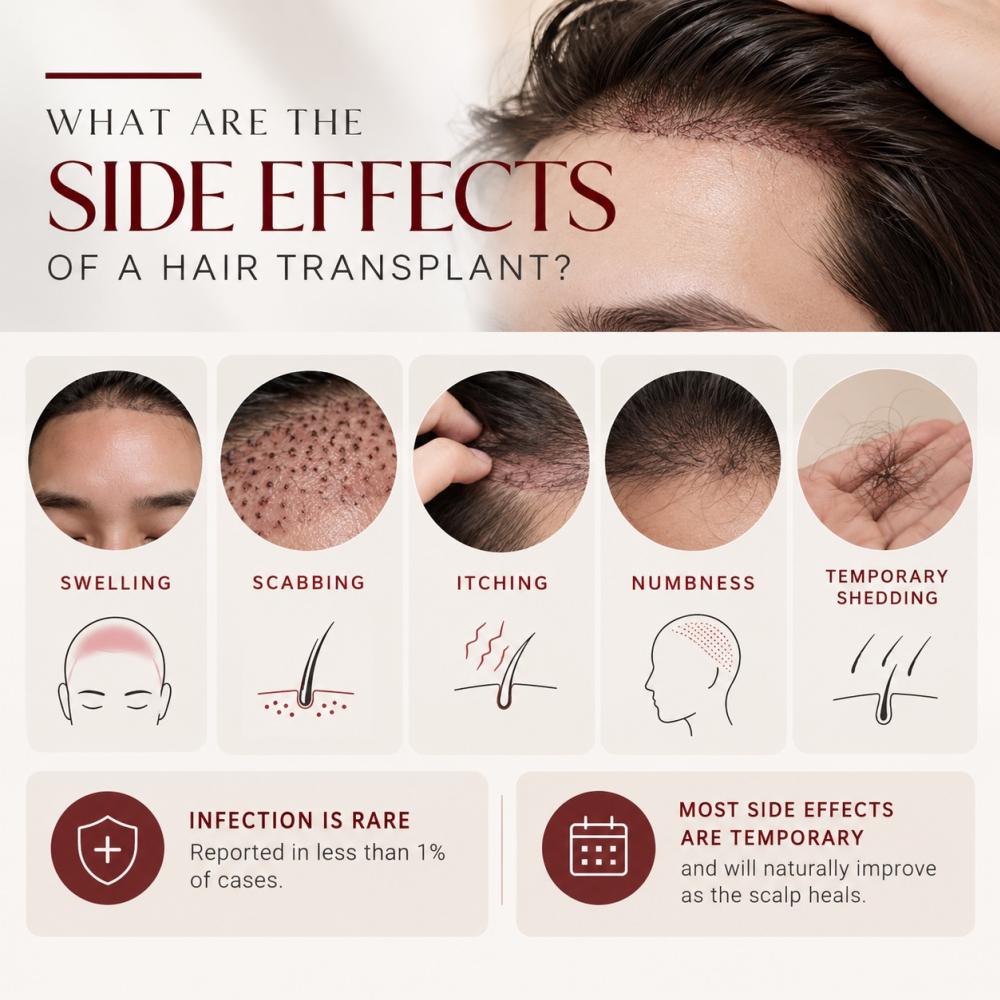
Most side effects are temporary and will naturally resolve if you follow your doctor’s aftercare instructions:
Swelling: Mild swelling around the forehead is common during the first 2-5 days post-surgery. It is caused by the local anesthesia and fluids used during the procedure and will subside on its own. Using a cold compress on the forehead can help.
Scabbing: Small scabs will form at the newly transplanted graft sites. These will dry and fall off within 1-2 weeks. Do not pick or scratch them, as this can dislodge the newly implanted hair follicles.
Itching: As the incisions heal, your scalp may feel itchy. You may gently pat or lightly scratch the donor area (the area at the back of the head where hair follicles were extracted). However, scratching the implanted area is strictly prohibited for the first 2 weeks.
Numbness: You may experience temporary numbness on your scalp due to minor nerve disruption during the extraction and implantation process. Sensation typically returns to normal within a few weeks to a few months.
Shock Loss (Temporary Shedding): This is a very common phase where the transplanted hairs (and sometimes surrounding natural hairs) shed within 2-4 weeks after the surgery. Do not panic—this is simply the hair follicles entering a temporary resting phase before growing new, healthy and permanent hair.
Infection after a hair transplant is rare and has been reported in less than 1% of cases, particularly when the procedure is performed under sterile conditions and proper post-operative care is followed.
Serious complications are uncommon. Most patients can return to their normal daily activities within a few days, while the transplanted hair gradually enters its natural growth cycle over the following months.
 : 116-118, Soi Chan 16 Chan Rd.,
Thung Wat Don, Khet Sathon, Bangkok, 10120
: 116-118, Soi Chan 16 Chan Rd.,
Thung Wat Don, Khet Sathon, Bangkok, 10120
 Open hours
: 10 AM – 6:30 PM
Open hours
: 10 AM – 6:30 PM
 Tel. :
064-978-9242
Tel. :
064-978-9242
 E-mail :
warodomhaircenter@gmail.com
E-mail :
warodomhaircenter@gmail.com
.png) Line ID :
@warodomclinic
Line ID :
@warodomclinic
 WhatsApp :
+66649789242
WhatsApp :
+66649789242
 Free consultation! Tel. 064-978-9242
  Consult / Booking